Lakeview Motel, Chilton, WI

Lakeview Motel in the Snow, Highway 55 at County F, Chilton, Wisconsin (12.14.2013)
© J. Shimon & J. Lindeman
Not far from Lake Winnebago, this mid-century motel on Highway 55 still operates
with a restaurant and deck to view sunsets.

  • Digg
  • Del.icio.us
  • StumbleUpon
  • Reddit
  • RSS

Found: The Great White Way, Appleton, WI

Found: The Great White Way, Appleton, Wisconsin. Postmarked Appleton, Wis. May 1, 1909.
Written in fountain pen on backside and addressed to a recipient in Oconto Falls, Wisconsin:
"How do you like the weather? It snowed here yesterday and last night about
5 inches on the level and today it is getting colder. What will come next?
I would like to be home this morning for a hunt. It ought to be great today.
It must be great farming. Tomorrow evening the recital of the Girls Glee Club comes off."
What was once obvious becomes an enigma over time. Could "The Great White Way" caption on this lithographed postcard refer to the first electric Christmas lightsinstalled on College Avenue in 1908 illuminating the December snow? Appleton is the home of a several electrical firsts. It's the site of the first hydro-electric station in 1882, the first electric streetcar in 1886, and the first electric street lights outside the east coast replacing the earlier gaslights in 1912. The postcard illustrates the culmination and evolution of these technologies in one graphic shot.

  • Digg
  • Del.icio.us
  • StumbleUpon
  • Reddit
  • RSS

Residence (Peace on Earth), Wayside, WI

Residence (Peace on Earth), Man-Cal Road near Wayside, Wisconsin (12.2.2013)
Chanting the Mantra Peace on Earth in Wayside, Wisconsin 2013. Do they believe it? Do they live it?

  • Digg
  • Del.icio.us
  • StumbleUpon
  • Reddit
  • RSS

Tinker Tot Drive-In, Ladysmith, WI

Tinker Tot Drive-In, Highway 8 (Edgewood Avenue), Ladysmith, Wisconsin (7.11.2013)
© J. Shimon & J. Lindeman
The abandoned Tinker Tot Drive-In survived the Ladysmith tornado of 2002.
Many places in the town did not. We always admired its "ruins" standing
along Highway 8 across from the Hi-Way 8 Motel.

  • Digg
  • Del.icio.us
  • StumbleUpon
  • Reddit
  • RSS

Found: Indian Bowl, Lac du Flambeau, WI

Found: Indian Bowl, Lac du Flambeau, Wis.
Made by Dexter, West Nyack, NY. Published by Wyman Post Card Co., Wausau, circa 1951
In his 2003 essay Simulating Culture: Being Indian for Tourists in Lac du Flambeau's Wa-Swa-Gon Indian Bowl, anthropologist Larry Nesper wrote that "After the Second World War, increasing numbers of tourists traveled to the Northwoods of Wisconsin to recreate. Lac du Flambeau Chippewa Indians encouraged this process by availing themselves as fishing guides and by building in 1951 the Indian Bowl, within which they staged Indian dances and related cultural performances." Nesper goes on to argue that a simulacrum of Indian culture in the Northwoods was produced. Today this roadside attraction, illustrated with a photograph from the road showing a brand spanking new 1951 Cadillac parked out front, is now in peril and needs support. Organizers of a restoration effort no longer criticize crass tourism, but acknowledge its importance and that tourism dollars are key to preserving the historic Indian Bowl and outdoor amphitheater. The Indian Bowl facility hosted Pow Wows, Ojibwe dance, and cultural events for decades. The plan it to create a unified multicultural native arts center to be known as the Lac du Flambeau Cultural and Performing Arts Center with a mission to preserve and showcase native culture and heritage.

  • Digg
  • Del.icio.us
  • StumbleUpon
  • Reddit
  • RSS

Found: High Council Campfire, Waupaca, WI

Found: "High Council Campfire" Boys' & Girls' Brigade.
Camp Onaway, R.R. 6 - Box 2015, Waupaca, WI 54981.
Photo of Don Weber by Rick Erdmann.
Kolorvue Post Card Co., New York, circa 1970s-1980s.
The Boys' & Girls' Brigade established Camp Onaway near Waupaca in 1910 with a goal of "building leadership" through providing an isolated place for kids to "rough it" hence learning survival and leadership skills. Perhaps the aftermath of French explorer Jean Nicolet's romanticized mission and the legendary fortitude of subsequent wilderness explorers in the pursuit of freedom.  Board member Don Weber in Native American costume presides over a smoking fire at the camp on this postcard.

  • Digg
  • Del.icio.us
  • StumbleUpon
  • Reddit
  • RSS

Found: Landing of Nicolet, Green Bay, WI

Found: Landing of Nicolet, Green Bay, Wis.
Verso reads: This mural decoration on south wall of east entrance hall of Brown County Court House,
represents the Landing of Jean Nicolet at Red Banks in 1634. He was the first white man to explore this region.
Published by Bosse's New Depot Green Bay, Wis. circle 1934.
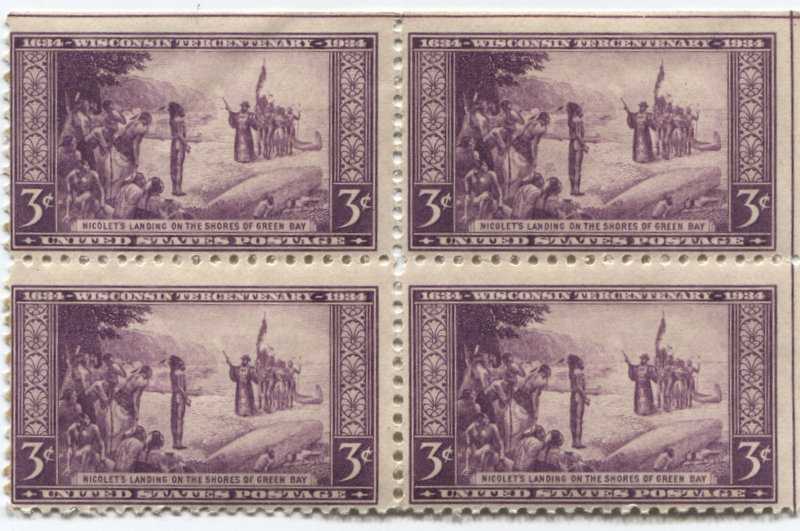
The "Landing of Nicolet" postcard interpretation of a 1910 mural painting by Milwaukee-based panorama painter Franz Edward Rohrbeck illustrates the mythic landing of the young French woodland explorer Jean Nicolet in 1634 in Green Bay, Wisconsin. Nicolet had been living with the Alqonquin tribes (his guides are shown in the canoe behind him) in the wilderness as part of his hot pursuit of fur (mainly beaver) and an ocean trade passageway to China. Native Ho-Chunk people are shown as exotic and cowering while offering the ceremonial calumet while rock star Nicolet, clad in ostentatious silk robe (said to be Chinese damask) accesorized by glistening pistols, asserts his authority. Another artist in another time may have illustrated the spectacle as more peaceable and cooperative, but this performative show of domination apparently resonated culturally in the early 20th century in Northeastern Wisconsin. Based on a mural painting (restored by Conrad Schmitt Studios in 2010) at the Brown County Courthouse (100 South Jefferson Street, Green Bay), this postcard reflects an American social milieu where Native peoples were marginalized and colonialism was rationalized. So culturally canonical was this scene, that a version was used on a U.S. postage stamp in 1934 celebrating the Wisconsin Trecentenary of Nicolet's landing at "Red Banks".  The stamp version was based on an earlier circa 1907 mural at the State Capitol in Madison by Edward Willard Deming who is said to have associated throughout his life with Native Americans and hence more clearly articulated the humanity of the natives in his mural. Note the phrase "The first white man"used in the postcard caption with no white guilt. The Wisconsin Trecentenary was also marked by ceremonies and a speech by FDR. The image can be read as evidence of the American power and identity struggles that enabled "the white man" to separate native peoples from their homelands.
Found: Wisconsin Trecenenary (1634-1934) postage stamp
Found: Landfall of Jean Nicolet in Wisconsin (1907)
 by Edward Willard Deming on view in the Wisconsin State Capitol in Madison

  • Digg
  • Del.icio.us
  • StumbleUpon
  • Reddit
  • RSS