Showing posts with label Native American Indians. Show all posts

Found: Landing of Nicolet, Green Bay, WI

Found: Landing of Nicolet, Green Bay, Wis.
Verso reads: This mural decoration on south wall of east entrance hall of Brown County Court House,
represents the Landing of Jean Nicolet at Red Banks in 1634. He was the first white man to explore this region.
Published by Bosse's New Depot Green Bay, Wis. circle 1934.
The "Landing of Nicolet" postcard interpretation of a 1910 mural painting by Milwaukee-based panorama painter Franz Edward Rohrbeck illustrates the mythic landing of the young French woodland explorer Jean Nicolet in 1634 in Green Bay, Wisconsin. Nicolet had been living with the Alqonquin tribes (his guides are shown in the canoe behind him) in the wilderness as part of his hot pursuit of fur (mainly beaver) and an ocean trade passageway to China. Native Ho-Chunk people are shown as exotic and cowering while offering the ceremonial calumet while rock star Nicolet, clad in ostentatious silk robe (said to be Chinese damask) accesorized by glistening pistols, asserts his authority. Another artist in another time may have illustrated the spectacle as more peaceable and cooperative, but this performative show of domination apparently resonated culturally in the early 20th century in Northeastern Wisconsin. Based on a mural painting (restored by Conrad Schmitt Studios in 2010) at the Brown County Courthouse (100 South Jefferson Street, Green Bay), this postcard reflects an American social milieu where Native peoples were marginalized and colonialism was rationalized. So culturally canonical was this scene, that a version was used on a U.S. postage stamp in 1934 celebrating the Wisconsin Trecentenary of Nicolet's landing at "Red Banks".  The stamp version was based on an earlier circa 1907 mural at the State Capitol in Madison by Edward Willard Deming who is said to have associated throughout his life with Native Americans and hence more clearly articulated the humanity of the natives in his mural. Note the phrase "The first white man"used in the postcard caption with no white guilt. The Wisconsin Trecentenary was also marked by ceremonies and a speech by FDR. The image can be read as evidence of the American power and identity struggles that enabled "the white man" to separate native peoples from their homelands.
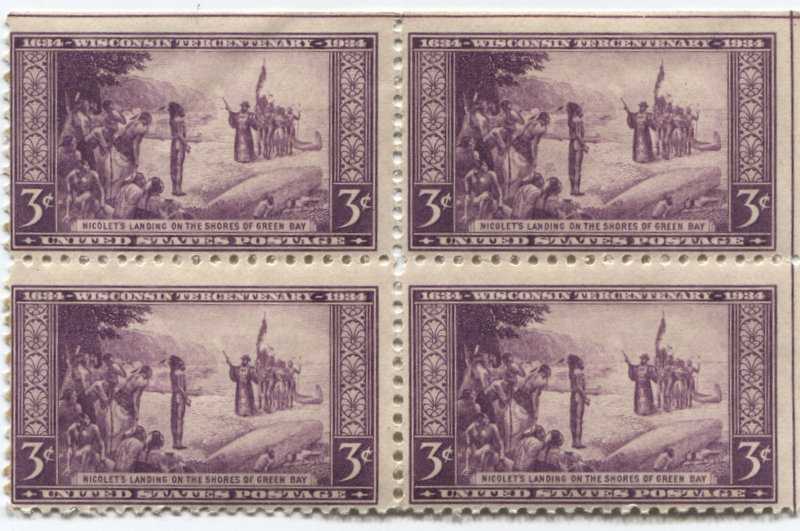
Found: Wisconsin Trecenenary (1634-1934) postage stamp
Found: Landfall of Jean Nicolet in Wisconsin (1907)
 by Edward Willard Deming on view in the Wisconsin State Capitol in Madison

  • Digg
  • Del.icio.us
  • StumbleUpon
  • Reddit
  • RSS

Found: Lance Little Eagle, Wisconsin Dells

Found: Lance Little Eagle, Native Winnebago Indian
 Wisconsin River Guide
Autographed and dated 7/24/76
Photo by John A. Trumble
Published by Dells Photo Service, Wisconsin Dells, Wisconsin
Circa 1960s

Found: FOOTPRINTS IN THE SAND mark the trail of a beautiful maiden as she welcomes
a visitor at sunset along the shores of the Wisconsin River.
Photo by John A. Trumble.
Published by Dells Photo Service, Wisconsin Dells, Wisconsin
Circa 1960s

John A. Trumble tapped into the fashion sensibilities of the swinging 1960s to depict "Native Winnebago Indians" in Wisconsin Dells. Kicky mini-skirted "Indian Maidens" and groovy long-haired bell-bottom wearing Indian boys predated Cher's glittery-feathered cover of a ballad of Cherokee-strife called "Half-Breed" in 1973 (written by Al Capps and Mary Dean). Trumble's images fueled the Wisconsin "tourism craze" for hiring native Americans as Wisconsin River Guides in the 1960s and 1970s. Selling autopgraphed postcard portraits of the guides for profit was integral and working for the tourism industry provided a livlihood for displaced Ho-Chunk (then known as Winnebago) whose other alternative was working the cranberry bogs. Though there is little evidence of Trumble's work accessible to us today, we note he self-published a 31 page book of his photographs titled The Dells of the Wisconsin River in 1965 and left a legacy of these kitschy Native American chic postcards to ponder.

  • Digg
  • Del.icio.us
  • StumbleUpon
  • Reddit
  • RSS

Found: Wa-ben-o-qua, She-we-ta-gis-in, Qua-bas-en-oqua, Antigo, Wis

Found: Wa-ben-o-qua, She-we-ta-gis-in, Qua-bas-en-oqua, Antigo, Wis. by A.J. Kinsbury copyright 1908.
"Dear Lena -- We are in the Northern part of Wis. Fishing is low this week, we didn't get any fish.
We expect to be back home the end of the week. Will write a letter as soon as we get home.
With love too all from Aunt and Uncle"
 Azo 7 EKD real photo postcard postmarked July 24, 1920 State Line, Wis.
We have come upon references to A.J. Kingsbury's un-politically correct portrayals of Native Americans: "Due to issues of cultural sensitivity, only 144 photographs, glass plate negatives, and postcards have been deemed appropriate by the Ojibwe and Menominee communities for display online." Still there are many that have been published in a small book titled Langlade County: Images of America by Richard Prestor and Joseph Hermolin published by Arcadia Publishing (April 2012). Would this portrait of Ojibwe or Menominee American Indians, possibly made near Antigo, be considered culturally insensitive? How'd that glistening barrel shot gun, glimmering Iron Cross (the punctum for us) and other western medals get there? Why is the central figure shrouded as if hiding? There is something haunting about the details even the text inked on to the negative so carefully--all of which seem obscure 110 odd years later. More mysteries are revealed upon close study of poses and personal construction of the subjects and pondering the text....

  • Digg
  • Del.icio.us
  • StumbleUpon
  • Reddit
  • RSS